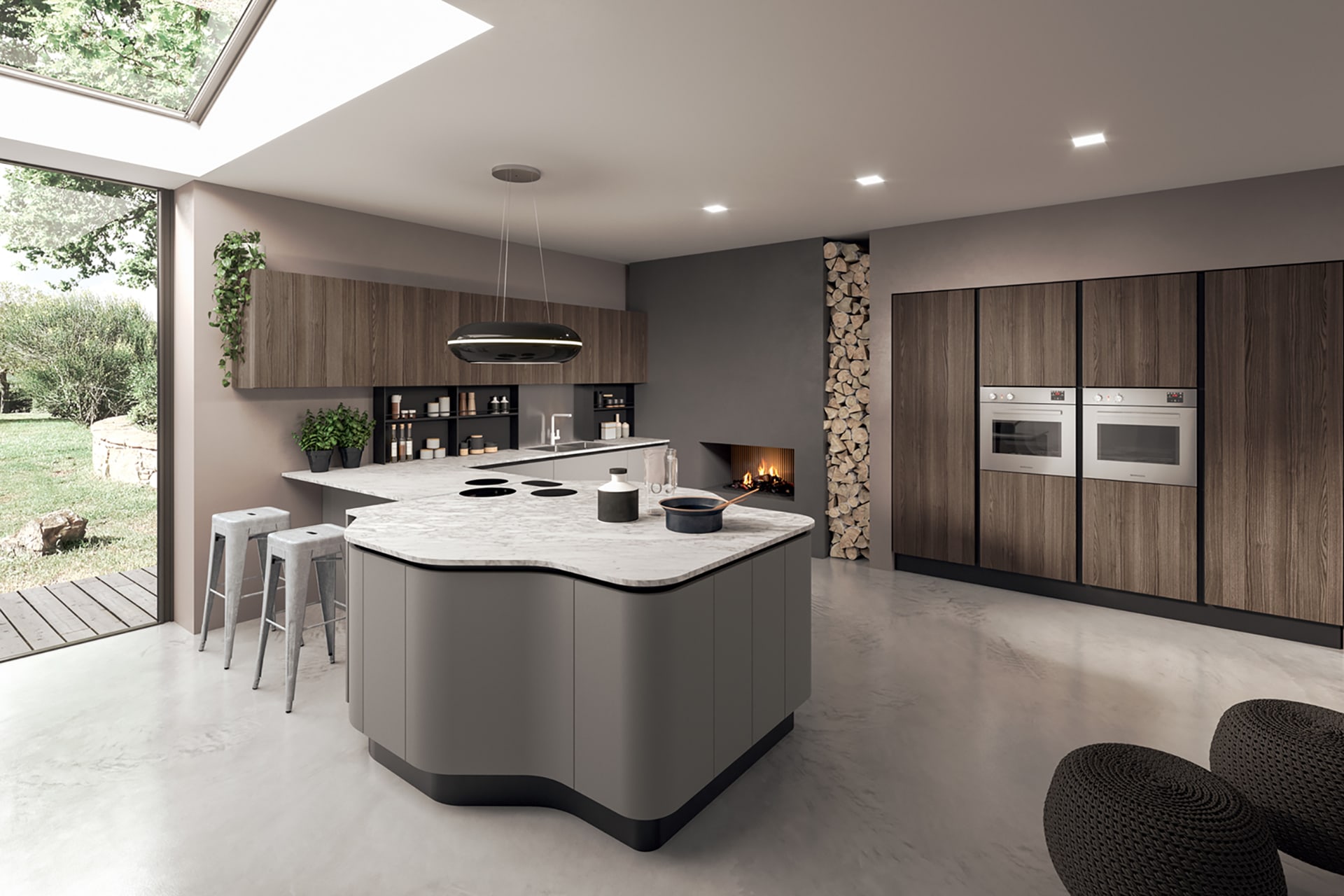
Will Italian Kitchen Cabinets Survive Miami's Humidity?
It is the first question we hear from nearly every homeowner who walks into our Boca Raton showroom. “I love the look of Italian kitchens, but I live in Miami. Will these cabinets actually hold up, or will I be dealing with warping and peeling in three years?”
It is a fair question. South Florida’s subtropical climate is one of the harshest environments for interior cabinetry in the United States. Relative humidity averages above 70% year-round. Salt-laden air reaches well beyond the coastline. UV light pours through floor-to-ceiling windows for 300 days a year. And the constant cycling between outdoor heat and indoor air conditioning creates condensation stress that most furniture materials were never designed to handle.
Italian kitchen cabinets do hold up, and they do so because they are specifically engineered for environments like this one.
What Actually Goes Wrong with Cabinets in Miami
Before explaining why Italian cabinetry performs well here, it helps to understand what fails and why. If you have lived in South Florida long enough, you have probably seen it firsthand.
Particle board swelling. Most mass-market cabinets use particle board for the cabinet box, shelving, and sometimes even door cores. Particle board is compressed wood fiber held together with resin. When sustained humidity penetrates the surface, the fibers absorb moisture, expand unevenly, and the panel warps, bubbles, or crumbles. In a Miami kitchen, this process can begin within two to three years and once it starts, the damage is permanent.
Delamination. Thermofoil and vinyl-wrapped cabinet doors are common in builder-grade kitchens. The vinyl membrane is glued to an MDF core. Heat and humidity weaken the adhesive bond over time, and the vinyl begins to peel at corners and edges. In South Florida, this is especially common near cooktops and dishwashers where steam accelerates the process.
Hardware corrosion. Standard cabinet hinges and drawer slides use zinc-plated steel. In coastal and high-rise environments where airborne salt is present, zinc plating corrodes within a few years. Drawers start sticking, hinges develop rust spots, and soft-close mechanisms lose their dampening.
Finish yellowing. Low-quality lacquers and laminates exposed to intense UV through large windows will yellow, fade, or chalk over time. White and light-colored cabinets are particularly vulnerable. What looked crisp at installation can appear dingy within five years.
Most Miami homeowners who have lived with builder-grade or big-box kitchens have seen at least one of these failures firsthand, often within the first five years.
How Italian Manufacturers Engineer for Humidity
Italian kitchen manufacturers export to every climate zone on the planet, from Scandinavian cold to Middle Eastern desert heat to tropical Southeast Asia. Climate durability has been part of the manufacturing process for decades, engineered from the core material outward.
Marine-grade construction
Italian manufacturers build cabinet boxes from marine-grade plywood and moisture-resistant MDF rated for environments exceeding 85% relative humidity. These cores are engineered to maintain structural integrity where standard particle board would fail within a few years. The internal shelving, drawer boxes, and back panels use the same moisture-rated materials throughout, including the parts behind appliances and inside corner units that nobody sees after installation.
Factory-applied lacquer systems
The finish on an Italian kitchen consists of multiple layers of polyurethane lacquer applied in climate-controlled spray booths at the factory, building up to 12 coats of UV-stabilized, moisture-sealed protection. Each layer is cured under controlled conditions before the next is applied. The result is a finish that resists humidity penetration, prevents yellowing from sun exposure, and maintains its appearance for decades rather than years.
Sealed edge banding
Exposed panel edges are the most vulnerable entry point for moisture. Italian factories apply laser-bonded edge banding that fuses the edge material to the panel, creating a completely sealed, waterproof joint invisible to the eye. This factory-level precision requires specialized equipment that only operates in a controlled production environment.
Anti-corrosion hardware
Every hinge, drawer slide, lift mechanism, and pull-out system from manufacturers like Blum, Hettich, and Salice uses nickel-plated steel, stainless steel, or anodized aluminum. These components carry salt-spray test certifications exceeding 200 hours, which means the soft-close mechanisms that work smoothly on day one will work the same way ten years later in a Brickell waterfront condo.
Fenix NTM surfaces
Fenix NTM, developed by the Italian company Arpa Industriale, is a nanotech surface with a non-porous composition that prevents moisture absorption entirely. It is anti-bacterial, anti-fingerprint, and thermally self-healing for micro-scratches, which is why it has become one of the most specified materials for kitchen islands and handleless door fronts across South Florida.
The Outdoor Kitchen Proof
We install Italian outdoor kitchens on Miami terraces, pool decks, and waterfront patios that are exposed to direct rain, full sun, and salt spray 365 days a year. These systems use the same marine-grade plywood construction, sealed lacquer finishes, and anti-corrosion hardware as the indoor kitchens we install.
If Italian engineering handles direct outdoor exposure in South Florida without warping, peeling, or corroding, your indoor kitchen with climate-controlled air conditioning is more than covered.
What to Ask Before You Buy Any Kitchen in Miami
These five questions apply to any kitchen purchase in South Florida, Italian or otherwise.
What is the cabinet box made of? Marine-grade plywood or moisture-resistant MDF are the materials that perform in South Florida. Standard particle board will swell and degrade within a few years in this climate.
How is the finish applied? Factory-applied, multi-layer cured lacquer outperforms any finish applied on site. Ask how many coats, whether UV stabilizers are included, and whether the process is done in controlled conditions.
What grade is the hardware? Ask for the salt-spray test rating. Nickel-plated steel or stainless steel with 200+ hour certification is the standard for coastal environments. If the answer is “standard” or “chrome-plated,” those hinges will corrode.
Are panel edges sealed? Laser-bonded edge banding is the current standard for moisture protection. If edges are glued with PVA adhesive, moisture will find its way in over time.
What does the warranty cover? Many manufacturer warranties include climate exclusions that void coverage for humidity-related damage, which is precisely the kind of damage most likely to occur in Miami. Read the fine print before signing.
Our Partners and South Florida Track Record
Our kitchen projects are built on ARAN Cucine and Guzzini e Fontana, two Italian manufacturers with decades of experience exporting to subtropical markets. ARAN produces over 90,000 kitchens per year using FSC-certified, moisture-resistant panels as standard across every collection. Guzzini e Fontana builds architectural kitchen systems with climate-grade lacquer finishes applied in sealed spray booths.
Both manufacturers produce kitchens that are installed in homes across Miami-Dade, Broward, and Palm Beach counties, from Fisher Island waterfront residences to Coral Gables estates to Key Biscayne condominiums. Our 5-year structural warranty covers material integrity in South Florida’s subtropical conditions with no climate exclusions.
For a detailed technical breakdown of every material and engineering method our Italian partners use, read our complete guide to Italian cabinetry and Miami’s climate.
Your Next Step
The best way to evaluate whether Italian cabinetry meets your durability expectations is to see and touch the materials in person. Visit our Boca Raton showroom to open Blum soft-close drawers, feel the difference between Fenix NTM and standard laminate, and compare marine-grade plywood to the particle board cores found in most retail kitchens. A private consultation is complimentary, takes about an hour, and comes with no obligation.