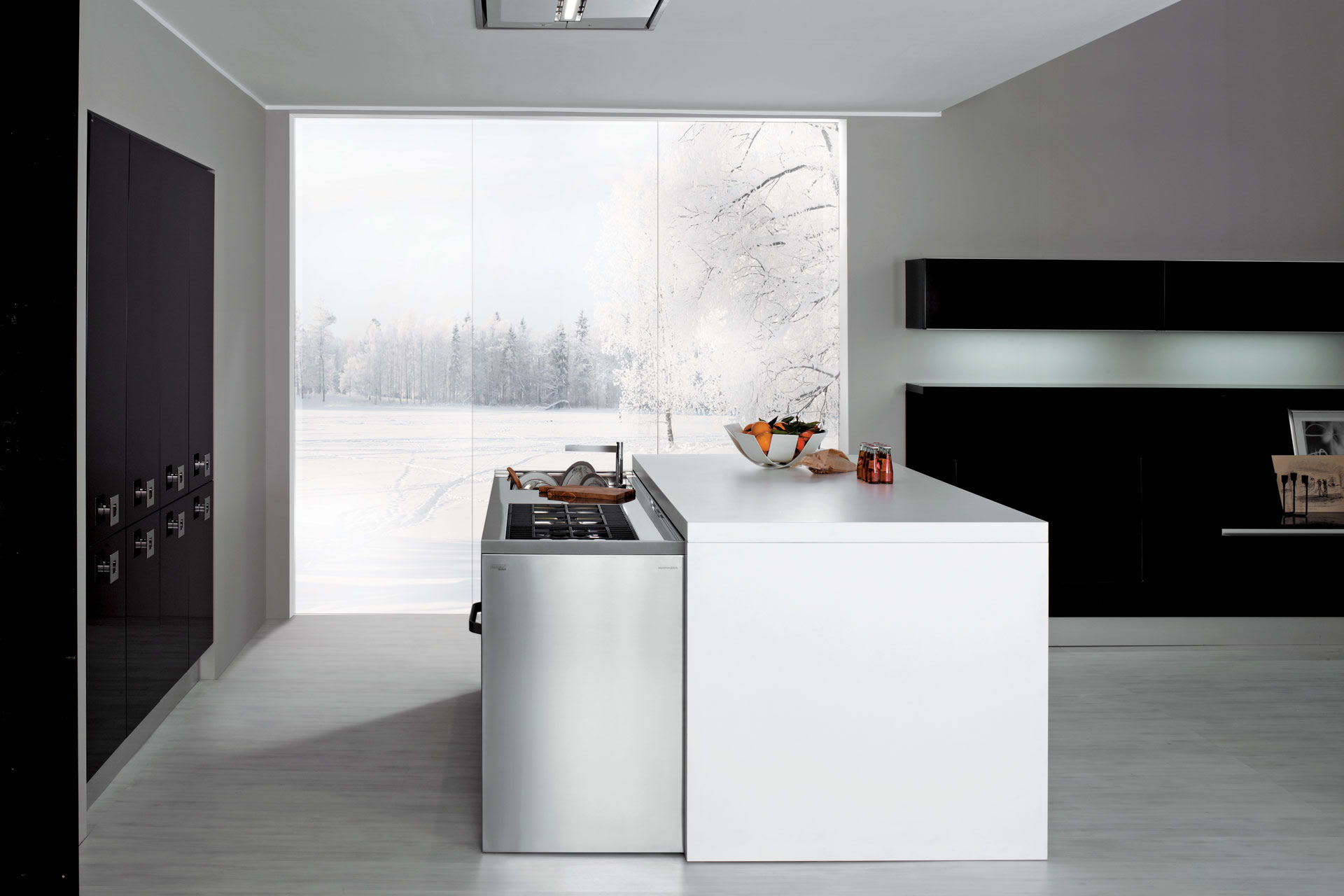
Authentic Italian Cabinetry vs. Look-Alike Alternatives
Walk through a kitchen showroom in South Florida and you will find dozens of brands with Italian-sounding names, ranging from companies that manufacture every component in Italian factories to those that design in Italy but produce overseas, to brands that have no connection to Italy beyond the name on the label.
For homeowners investing $50,000 or more in a kitchen, the difference matters. Italian manufacturing carries specific material standards, finishing processes, and engineering methods that directly affect how cabinetry looks, performs, and holds up over time. Paying a premium for Italian-made quality and receiving something produced to a different standard is a legitimate concern, and one we hear regularly at our showroom.
The following sections cover how to tell these production models apart, what questions to ask, and how to verify that the cabinetry you are buying is genuinely manufactured in Italy.
Three Production Models on the Market
The Italian kitchen industry is global, and products reach Miami through several different channels. These are the three production models you will encounter.
Designed and manufactured in Italy
The entire product is conceived, engineered, and built in Italian factories. Raw materials arrive at the production facility, and finished cabinets leave it. The factory address is in Italy, the workforce is Italian, and the quality control happens on Italian soil. When the product arrives in Miami, it comes with Italian customs documentation and a bill of lading from an Italian port.
This is what most homeowners mean when they say they want an “Italian kitchen.”
Designed in Italy, manufactured elsewhere
A legitimate Italian design studio creates the aesthetic and the engineering specifications, but production happens in a factory outside of Italy, often in Eastern Europe or Southeast Asia. The design DNA is Italian, but the materials, finishing processes, and quality control follow the standards of the country where manufacturing takes place. These products can be well made, but the materials and processes are different from what comes out of an Italian factory.
Italian name, no Italian production
A brand uses an Italian-sounding name for marketing purposes, but neither design nor manufacturing happens in Italy. The products may be perfectly functional, but the Italian association is a branding decision rather than a statement about origin or manufacturing standards. This model is more common than most homeowners realize.
How to Verify Authenticity
Telling these three models apart requires asking specific questions. A reputable dealer will answer all of them without hesitation.
Ask for the factory address. A genuinely Italian-made kitchen comes from a specific production facility in a specific Italian town. ARAN Cucine manufactures in Atri, Abruzzo. Guzzini e Fontana operates from Pesaro, Marche. If the dealer cannot name the factory location, or the answer is vague (“our products are sourced from Italy”), that is worth investigating further.
Ask about import documentation. Every product that enters the United States from Italy passes through customs with documentation that includes the country of origin, the port of departure, and the manufacturer. A bill of lading from the Port of Genoa or the Port of Naples is a straightforward record of where the product actually came from. Dealers who import directly from Italian factories have this documentation for every shipment.
Check the manufacturer’s own website. Italian kitchen manufacturers list their authorized dealer networks on their websites. If The Italian Cabinet claims to be an authorized ARAN Cucine dealer, you can verify that directly with ARAN. If a showroom claims to carry an Italian brand but that showroom does not appear on the manufacturer’s dealer locator, ask why.
Look at the hardware. Italian kitchen manufacturers use European hardware systems from Blum (Austria), Hettich (Germany), or Salice (Italy). These are precision-engineered components with specific model numbers and certifications. If the hardware is unbranded or uses a manufacturer you cannot find independently, the cabinets may have been produced outside of the European supply chain.
Ask about the core material. Italian manufacturers use moisture-resistant MDF and marine-grade plywood, and they will specify exactly which standard their panels meet. If the answer is “wood” or “MDF” without further detail about moisture rating or certification, the product may be built to a different material specification than what Italian factories produce.
Why Manufacturing Location Affects Quality
The difference between Italian-made and Italian-sounding goes beyond branding, because Italian kitchen manufacturing involves specific processes tied to the factory infrastructure itself.
Lacquer application in an Italian factory happens in sealed, climate-controlled spray booths with automated application systems that build up to 12 layers of UV-stabilized polyurethane. Each coat is cured under precise temperature and humidity conditions before the next layer is applied. This process requires specialized equipment that represents decades of capital investment. The resulting finish resists Miami’s humidity and UV exposure far longer than a two-coat spray finish applied in a less controlled production environment.
Edge banding at Italian factories uses laser-bonding technology that fuses the edge material to the panel at a molecular level, creating a completely sealed, waterproof joint with no visible seam. This equipment costs millions of euros per production line, which is why most factories outside of Italy still use PVA adhesive, a glue-based bond that can degrade over time in humid climates.
Quality control in Italian production facilities operates under EU manufacturing standards, including formaldehyde emission limits (E1/E0.5 class), FSC chain-of-custody certification for sustainable sourcing, and ISO quality management systems. These standards are audited and verified by third-party certification bodies.
Our Manufacturers and Where They Produce
Every kitchen, wardrobe, door, bathroom, and flooring product we sell is manufactured at a specific factory by a specific company, and we can document the origin of each one.
ARAN Cucine produces kitchens in Atri, Abruzzo, Italy. Founded in 1962. Italy’s largest kitchen manufacturer, producing over 90,000 kitchens per year. FSC-certified. We are an authorized dealer for South Florida.
Guzzini e Fontana produces kitchens in Pesaro, Marche, Italy. Their factory builds architectural kitchen systems with climate-grade finishes applied in sealed spray booths.
Pail produces interior doors in their factory in the Veneto region. One of Italy’s established door manufacturers with a full range of interior door systems.
BMT Bagni produces bathroom furniture in Pesaro, Marche, Italy. Bathroom vanities, storage systems, and mirror cabinets designed for high-humidity environments.
GB Groupe produces bathroom furniture in Villanova di Fossalta di Portogruaro, Veneto. Compact and full-size bathroom collections.
Casali produces glass doors and partitions in Bologna, Emilia-Romagna, Italy. Decorative glass, sliding systems, and room dividers.
Skema produces flooring and wall panels in Treviso, Veneto, Italy. SPC, laminate, and engineered wood flooring systems.
Miele produces appliances in Gutersloh, Germany. The only non-Italian manufacturer in our portfolio, and our exclusive appliance partner for kitchen projects in South Florida.
All eight manufacturers, seven Italian and one German, list verifiable factory addresses and confirmable dealer authorizations on their websites.
How Our Supply Chain Works
The path from Italian factory to your Miami home involves a documented chain of custody that is difficult to replicate with products of uncertain origin.
It starts with a 3D design created in collaboration with the manufacturer’s own specification software. The order goes directly to the factory in Italy, where it enters production as a made-to-measure project built specifically for your space. Manufacturing takes four to five weeks depending on the complexity of the project.
Finished cabinets are crated at the factory, trucked to an Italian port, and shipped by ocean freight to Miami. The transit takes approximately eight weeks. At the Port of Miami, the shipment clears U.S. customs with full documentation of origin, contents, and manufacturer. Our logistics team coordinates delivery to your home, and our certified installation crew handles the final assembly.
Every step in this process generates documentation: factory production confirmations, shipping manifests, customs declarations, and delivery receipts. For homeowners who want full certainty about where their kitchen was made, this paper trail covers every link in the chain.
For a detailed timeline of each phase, read our guide to Italian cabinet lead times and shipping to Miami.
Your Next Step
Visit our Boca Raton showroom to see products from all eight manufacturing partners in person. Examine the construction quality, open the Blum soft-close hardware, and feel the difference in lacquer finishes. We keep manufacturer catalogs, material samples, and authorization documentation on site. A private consultation is complimentary, takes about an hour, and comes with no obligation.